
How Gone Girl exposed the 'Cool Girl' trope and changed the course of modern feminism
Gillian Flynn's 2012 thriller was hotly anticipated as a white-knuckle whodunnit, but the real plot twist of Gone Girl was its polemic against patriarchy which turned a crime fiction into a feminist masterpiece.


In 2012, fans of Gillian Flynn eagerly awaited the release of her new, hotly anticipated crime thriller. The writer had previously enraptured audiences with Sharp Objects (2006) and Dark Places (2009) which followed the lives of women navigating moody and dramatic landscapes, solving crimes and unpacking a troubled past. Her sharp, acerbic writing is packed full of suspense and her complex female protagonists are easy to root for, and sometimes, just as easy to hate.
Little did audiences know, Flynn's 2012 release would test them even more. Gone Girl is contemporaneously hailed as her feminist masterpiece - although you wouldn't know that going into the theatre. The film centres around our male protagonist, Nick Dunne, whose wife Amy mysteriously goes missing and audiences are invited to question Nick's culpability.
However, at the climax of the film (WARNING: SPOILERS!), Amy Dunne reveals that she has masterfully coordinated her own disappearance after discovering her husband is having an affair. Amy is laser-focused on destroying Nick's life after she claims he destroyed hers, and found himself a "newer, younger, bouncier" model.

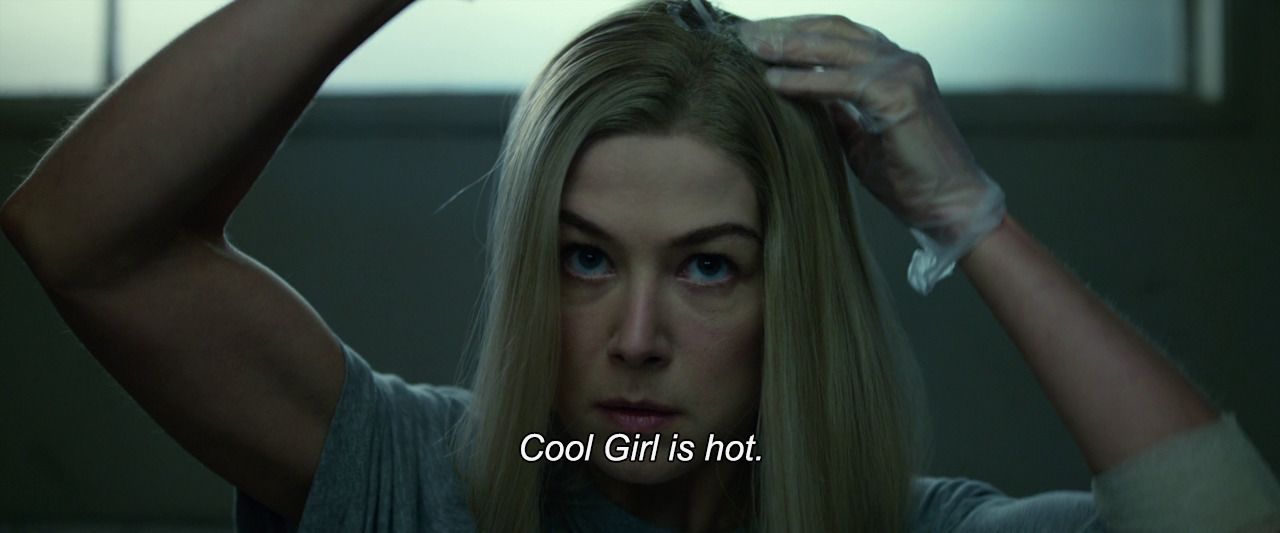
Gone Girl, directed by David Fincher (2014, New York, Regency Enterprises, 20th Century Fox)
Gone Girl, directed by David Fincher (2014, New York, Regency Enterprises, 20th Century Fox)
Gone Girl, directed by David Fincher (2014, New York, Regency Enterprises, 20th Century Fox)
The 'Cool Girl' monologue
Gone Girl, directed by David Fincher (2014, New York, Regency Enterprises, 20th Century Fox)
Through the praxis of Amy's cool, collected, tightly-wound female rage, Flynn presents us with what is now known as the notorious 'Cool Girl' monologue:
Gone Girl, directed by David Fincher (2014, New York, Regency Enterprises, 20th Century Fox)
"Nick loved a girl I was pretending to be. Cool girl. Men always say that as the defining compliment, don’t they? She’s a Cool Girl. Being the Cool Girl means I am a hot, brilliant, funny woman who adores football, poker, dirty jokes, and burping, who plays video games, drinks cheap beer and jams hot dogs and hamburgers into her mouth while somehow maintaining a size 2, because Cool Girls are above all hot. Hot and understanding."
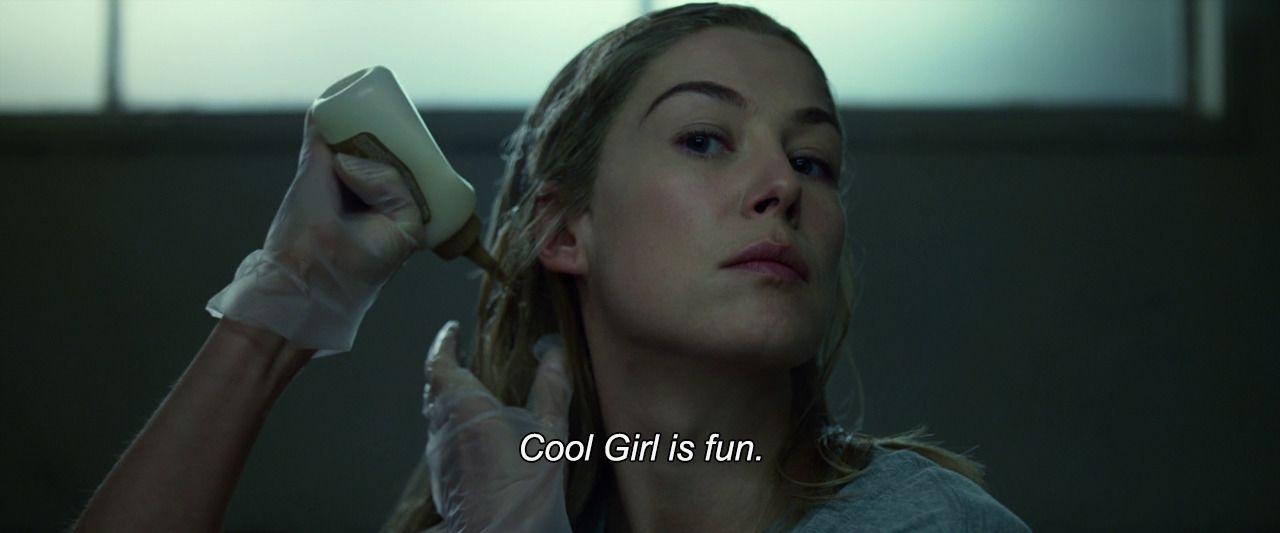
Gone Girl, directed by David Fincher (2014, New York, Regency Enterprises, 20th Century Fox)
Gone Girl, directed by David Fincher (2014, New York, Regency Enterprises, 20th Century Fox)
How the 'Cool Girl' trope manifests
Flynn's suggestion that 'The Cool Girl' is men's "defining compliment" is a nod to the ways in which patriarchal preferences dominate popular culture.
If 'The Cool Girl' is the ultimate form of femininity, and men run the vast majority of the media, female audiences will be fed this trope from the age when their eyes can register colour and their ears can register sound, ad nauseam.
As a result, we have seen 'The Cool Girl' trope pop up in numerous forms of media.
We see it in Megan Fox's breakout role of Mikaela Banes, in Transformers (2007).
Mikaela knows how to fix cars, shoot the shit with the guys and most importantly - look absolutely immaculate the entire time
As 'The Cool Girl', Mikaela never challenges her male counterparts but compliments them and serves to make both look and feel better.

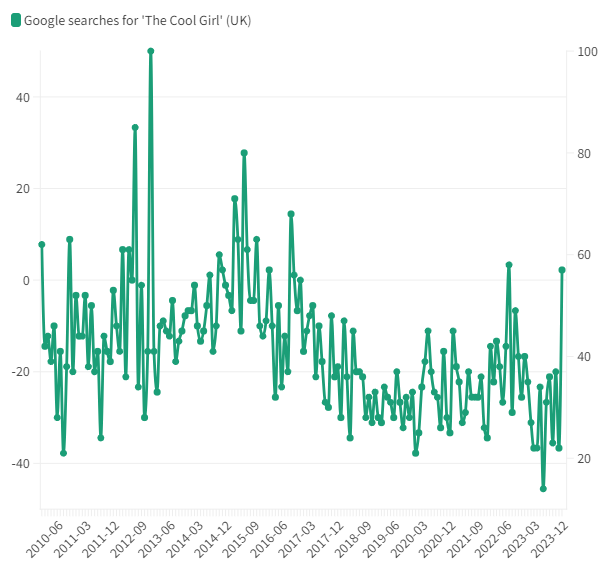
Interest in "The Cool Girl" on Google between 2010-2023
Interest in "The Cool Girl" on Google between 2010-2023
As Flynn elaborates:
"Cool Girls never get angry; they only smile in a chagrined, loving manner and let their men do whatever they want."
"Go ahead, shit on me, I don’t mind, I’m the Cool Girl."


The 'Cool Girl': a mouthpiece for female rage
Flynn's diatribe is explicit, vulgar and packed with female rage. In it, Amy makes repeated reference to her sexualisation within her marriage and within society writ large - resulting in her commoditisation as a two dimensional character in the eyes of men around her. As she drives, she observes the women around her and makes the following inferences:
"She like what he likes. So, evidently, he’s vinyl hipster who loves fetish manga. If he likes girls gone wild, she’s a mall babe who talks football and endures buffalo wings at Hooters."
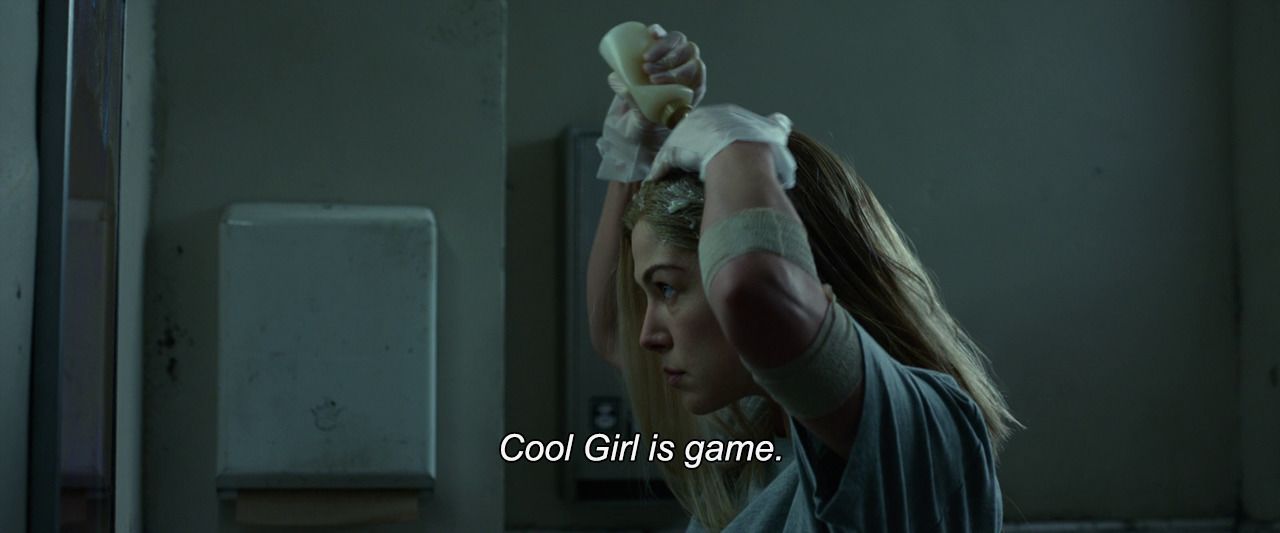
Gone Girl, directed by David Fincher (2014, New York, Regency Enterprises, 20th Century Fox)
Gone Girl, directed by David Fincher (2014, New York, Regency Enterprises, 20th Century Fox)
She expresses her resentment at the years she spent conforming to this trope as a means by which to endear her husband to her.
"When I met Nick Dunne, I knew he wanted a Cool Girl and for him, I’ll admit, I was willing to try. I drank canned beer watching Adam Sandler movies. I ate cold pizza and remained a size 2."


Gone Girl, directed by David Fincher (2014, New York, Regency Enterprises, 20th Century Fox)
Gone Girl, directed by David Fincher (2014, New York, Regency Enterprises, 20th Century Fox)
Amy Dunne's curtain call
The purpose of the 'Cool Girl' monologue is to establish a climactic moment where the audience, who has insofar only experienced Nick's perspective, to be able to empathise with Amy. As the plot of the film progresses and so does Amy's violence, audiences will invariably begin to distance themselves from our Amy recognising her as not the wounded victim, deserving of sympathy, but as a violent sociopath, hellbent on revenge.
This may result in an uncomfortable emotional experience for female audience members who may have previously empathised, or indeed, identified with Amy. This is precisely Flynn's intention when she carries them through her emotional wringer with her. Flynn takes aim at the establishments which codify and normalise tropes that harm women and serve men such as the 'Cool Girl'.
She wants her audience to travel with Amy through her miserable marriage and tap into their own dormant female rage.
She wants her audience to examine and disseminate their own experiences of being moulded into the 'Cool Girl' to satiate the male gaze.
She wants her audience to question where the line is between righteous anger and violence, and pulls no punches in doing so.
And just because Amy Dunne is the villain of Gone Girl, this should not disqualify her contributions into modern feminism and the light she sheds into female rage.
After all, even a broken clock is right twice a day.


Gone Girl, directed by David Fincher (2014, New York, Regency Enterprises, 20th Century Fox)
Gone Girl, directed by David Fincher (2014, New York, Regency Enterprises, 20th Century Fox)
 Built with Shorthand