
'It's given me a new chance of life'
Inside London's 1000-degree playground
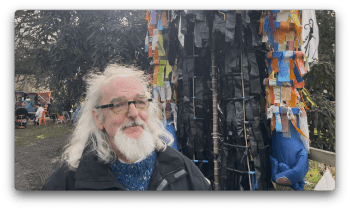
William Rodriguez perches on the side of an anvil as he explains how he first had the idea to set up a blacksmithing forge in a sleepy south west London suburb.
By day, he is a metal technician at Kingston University, yet much of his free time is spent in a shed full of curiosities now known as the Surbiton Community Forge.
Inside the workshop, a dry scent of resin and sawdust lingers around the aprons and tools cramming the walls. Two taxidermied antelopes stare at the front door, while the back of the room is reserved for half-finished projects and a hydroponics fish tank.
Outside, the forge’s gas supply just been turned off after a sunny day in early April, and a papery dust from the fire has settled on any nearby surface. A poster flutters against the mesh-iron fences which do little to keep the afternoon’s metallic clangs away from Tolworth’s community allotments.
William points it out as he prepares to lock up for the evening. It reads: “Everyone can be brilliant if they are given the support and encouragement.”
He makes it clear he believes it.

William, volunteer and co-founder of the Surbiton Community Forge
William, volunteer and co-founder of the Surbiton Community Forge


“Blacksmithing is a dying craft”, William explains.
“You see it in movies, but getting access to a local blacksmithing forge where you can learn is very rare.
It is far from the trendy arts-and-crafts activity that many will have scheduled into their calendar amidst the overwhelming number of creative days out in the capital.
At least on the surface, blacksmithing doesn’t have the peaceful allure of a North London pottery café, nor an evening spent life drawing with a cocktail by the side of your easel.
You emerge with soot-stained cheeks, pulling off your steamed-up safety goggles only to realise you are barely even in London.
But for the last three years, co-founders William and Ian Turnbull have spent their weekends voluntarily teaching any willing attendee the basics of blacksmithing.
William laughs with a hint of disbelief at the fact that these 'experience days' now have a waitlist, but the unique appeal is not hard to understand.
“By the afternoon this place sounds like a proper forge. Everyone is hammering and shaping something. Very quickly they get in tune with the vibe of this place,” he says.
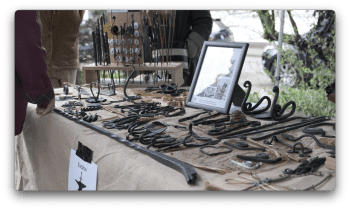
By now, the pair have set hundreds on the path to making metalworks that range from snails and fire pokers to swords and roses.
Watch how visitors to one experience day got on at the forge
'By the afternoon this place sounds like a proper forge. Everyone is hammering and shaping something. Very quickly they get in tune with the vibe of this place'
- William
'We don't believe in mistakes'
But behind William and Ian’s passion for teaching blacksmithing, the forge has a goal that runs deeper than the Sunday sessions.
When it was forming as an idea in William’s mind, he wanted to create a space that was welcoming for people with learning disabilities, recovering from addiction, or experiencing loneliness.
“When we say we open it up for the community, we really mean it. The mentality of how myself and the rest of the volunteers are running the forge is we approach everything with zero judgement.
“We don’t believe in mistakes. Everything that you are doing, regardless of how it goes, is a learning step towards improving your skills.”
He pauses, reflecting on how he has seen the forge impact people’s lives in difficult moments. It seems he doesn’t have the chance to do this often.
“Addiction will sever your relationships with family, friends, and colleagues. But when people come here, immediately they become friends, they become part of the group.
“This place has helped a few people to recover faster, or to open their own business because they learn a few skills in here. That alone makes me happy.”

Ian Turnbull (right), volunteer and co-founder
Ian Turnbull (right), volunteer and co-founder


Permission to be brilliant
The forge is supported by a local organisation called The Community Brain, which has made a name for itself in Kingston by running wacky local festivals and hosting silent discos in the local train station.
Yet the forge is part of several longer-term projects connected to the organisation which do not shout quite so loudly.
Robin Hutchinson, the Community Brain’s director and founder, says that the charity’s mission is to make ‘playgrounds for adults’, creating an environment where people feel confident to pursue something new.
“We have this sort of saying within The Community Brain, which is ‘permission to be brilliant’. And the bit that saddens me over the years is the number of people who need somebody else to tell them it's okay to do what they want to do.”
Robin, too, has needed to hear this permission himself. Due to his own mental health issues, he had years of feeling unable to write, influenced in part by a lack of confidence over what he describes as his ‘appalling’ spelling.
“One day I just started writing a few things, and I suddenly thought, why have I done this to myself? Why have I punished myself by telling myself I'm not good at doing so?’”
Now, an array of his short stories such as ‘The Legend of Lefi Ganderson’ and ‘The Last Sardines’ tell reimagined tales of places in Surbiton that are celebrated each year in the Community Brain’s festivals.
“It can be overwhelming at times, this sense that you can't do something. And actually, the real game is to allow yourself to try again,” Robin says.
"There's enough people in the world will tell you you're rubbish. Somehow you've got to find a voice in yourself that says, ‘yeah, okay, I'm going to try this.'”
'There's enough people in the world will tell you you're rubbish. Somehow you've got to find a voice in yourself that says, ‘yeah, okay, I'm going to try this''
Robin’s enthusiasm for promoting creativity emerges from a belief that schools and workplaces educate children out of creativity and deskill adults by over-managing them.
“Actually,” he says, “What we find is in the playgrounds, people remember what made them passionate, what they wanted to do, and where they found joy. And they just experienced those emotions again by smashing a piece of metal about or planting something.”
The Community Brain’s ethos does not rest on unfounded belief. The amount of studies connecting creative pursuits with improved wellbeing is innumerable. In 2024, research by Anglia Ruskin University found that creative activities are as beneficial to life satisfaction as having a job, while a 2026 study by University College London found engagement with the arts helps to slow biological ageing.
But many children are losing early opportunities to pursue design and creativity in education. Over the last two decades, the number of children taking GCSEs in Design and Technology has plummeted, falling by over 75% between 2008 and 2025. Partly because the number of D&T teachers in state schools halved between 2011 and 2020, the chance for children to explore creative careers from an early age has been dwindling.
And such jobs are not diverse places. A 2022 report by the Centre for Economic Performance found that women, people from ethnic minority backgrounds, and people who grew up in low-income households are underrepresented as designers and inventors.
Aware of the growing appeal that creative careers hold, some universities and colleges have launched an array of adult retraining courses for creative industries. According to WMCollege in Camden, whose course involves career transition advice and financial guidance: “More adults are swapping spreadsheets for sketchbooks and boardrooms for studios. Across the UK, people are leaving corporate roles to follow their passions in art, design, and other creative fields.”
'It's given me a new chance of life'
One regular at the forge, Alex Campbell, is among many who’s whose exposure to creative opportunities – let along blacksmithing - was limited before he first went to an experience day.
Alex found the forge after the end of a seven-year relationship, and now reflects on how the support offered by Ian and William helped him regain faith in the community around him.
“I was very much a broken man, and it was very a difficult time on my mental health. It made me realise that there are people who do want to help, and the right people are still out there.”
Now splitting his time between running his personal training business and supporting his mother’s dog day care, Alex is working towards making his own line of candle and incense holders to sell.
“Whenever you make something, it is literally in your own image, you are effectively your own god. And when you make something, you know for the fact that no one else can make it the way you do.
“Blacksmithing has given me confidence in myself that I am capable of doing things with my hands and with tools. I'm capable of actually constructing something, and I can be creative in something which will last and people will see,” he explains.
'Whenever you make something, it is literally in your own image, you are effectively your own god'
After honing his skills at the forge over the last eight months, the spirit of the Community Brain has rubbed off. Now helping to volunteer at the forge himself, Alex is aiming to offer the same support to others that William and Ian first gave to him.
“It's given me a new chance of life, really. Coming away from personal training a little bit and just realising it's not all about that. I’ve realised I can make money from this, and realised more about myself and how I think, how I work, how I socialise, how I talk. It's just given me a new meaning about myself."
“I believe I've got a good future in front of me, as long as I just keep going.”
Emerging through the forge's therapeutic rhythm, there is a quiet secret that sits at its heart: for some, visiting does not have to be about blacksmithing at all.
"Blacksmithing is an excuse to come and improve yourself," William reflects.
"And it works."
Words, photos, and videos by Hamish McCorriston
 Built with Shorthand