
Meet the Brits opting to move abroad post-Covid
What shaped 'me'
I’ve lived as an expatriate for as long as I can remember. My mother set the pattern before I was even born — leaving her hometown at seventeen and stepping into a life that would never again be defined by a single country. South America, Africa, Japan, India — to put it simply, my world was the world.
I grew up believing borders were suggestions, not limits, and that life was meant to be lived in motion.
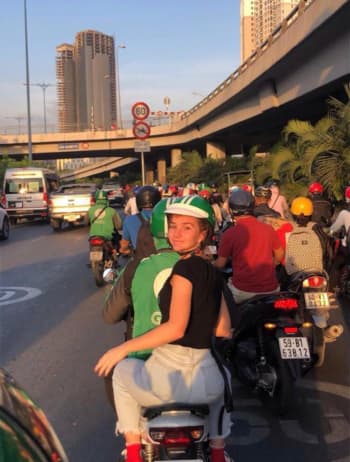
My parents spent a decade in the Solomon Islands, a small cluster of islands in the South Pacific, before relocating to Vietnam, where I would spend the first eighteen years of my life learning the world through humidity, motorbikes, and the rhythm of a place that became home without ever being “home” on paper.
At twelve, I moved again — this time to Malaysia — where school became a patchwork of accents, cultures, and friendships that understood transience as normal. Eventually, I found my way back to the UK for university, returning to a country that was technically mine but felt strangely foreign, as if I were arriving for the first time.
In a way, my life has unfolded in reverse to what many Brits are doing now. While thousands are packing up to chase new beginnings abroad, I grew up abroad and had to learn how to return.
My roots were never planted in one place — they were carried with me, shaped by every country I’ve called home.
Travel shaped me long before I understood what it meant to belong anywhere. After university, when most people were settling into their first jobs or their first leases, I felt an unmistakable pull in the opposite direction. I couldn’t think of anything I wanted more than to leave the UK. So I did what felt most natural — I kept moving.




I travelled back to the places that had formed me: Australia, the South Pacific, Taiwan, China, Bali, Singapore. In each place, I found pieces of myself I didn’t know I’d misplaced. And along the way, I met other British travellers — people like me who had slipped out of the UK with no real intention of returning, people who understood that home can be a feeling rather than a postcode.
For us, leaving wasn’t an escape. It was a continuation — of curiosity, of identity, of a life lived in motion.

Taiwan - Jiufen. Credit: Ella Iles
Taiwan - Jiufen. Credit: Ella Iles

Great Wall of China. Credit: Ella Iles
Great Wall of China. Credit: Ella Iles

Honiara, Solomon Islands. Credit: Ella Iles
Honiara, Solomon Islands. Credit: Ella Iles
The post‑covid shift
The growing trend of young people in their mid‑20s leaving the UK after the Covid‑19 pandemic — and choosing not to return has been steadily rising. With remote work, rising living costs, and a shift in lifestyle priorities, many young adults are redefining what “home” means.
When the world reopened after Covid, many young Brits expected to return to normality. Instead, they returned to something that felt smaller, tighter, and harder to navigate.
For 24‑year‑old Megan, the moment of clarity came while working remotely from a friend’s flat in Bali. “I realised I was happier in those few weeks than I had been in years,” she says. “I came to Bali with no job, that's how bad it was. But, I didn’t want to go back to a life that felt like survival.”
Her story is far from unique. Across Europe, Australia and Southeast Asia, young British expats are quietly building new lives — and very few are planning a return back to the UK.
The pandemic didn’t just disrupt routines; it rewired expectations. Megan fell into real estate - doing it fully remote. "It has been a dream." She said.
Remote work showed young people that life didn’t have to revolve around long commutes, cramped flats and burnout.
Many reassessed what they wanted from adulthood, and the UK — once a place of opportunity — suddenly felt restrictive.
If Covid planted the seed, the cost‑of‑living crisis watered it. Rising rents, stagnant wages and soaring bills pushed many young people to a breaking point.
In cities like Manchester, Bristol and London, rent increases outpaced salaries dramatically.
“I was spending over half my income just to exist, when I compared that to what friends abroad were paying, it felt ridiculous”
For many, the logic simply didn’t add up. Why stay in a country where financial independence felt impossible when other places offered more for less?

Interview with Megan Sewell
Interview with Megan Sewell
Something is shifting in Britain. Quietly, steadily, and in growing numbers — young people are leaving.
In the years before Covid, around 93,000 twenty-somethings packed their bags each year. Today that figure has surged past 135,000. That's nearly one and a half times as many young Brits choosing life elsewhere — and the numbers keep climbing.
What's striking isn't just how many are going. It's how early. A generation ago, Britons tended to emigrate in their thirties, once careers were established. Now they're going in their twenties, before they've even properly started.
The pandemic didn't start this trend. But it lit the fuse. And right now, Britain is struggling to put it out.
"Everything started working out as soon as I moved"
Megan Sewell, 24
Political fatigue and disillusionment
Beyond economics, a deeper political fatigue has taken hold. Years of instability — from Brexit to leadership changes to public service strain — left many young Brits feeling disconnected from the direction of the country.
This disillusionment created a powerful push factor: a sense that the UK wasn’t just struggling, but actively failing to prioritise its younger generations.
But leaving wasn’t only about escaping a limited reality. It was also about attraction — the pull of places offering affordability, adventure and a different pace of life.
Countries like Dubai, Australia, Canada, USA, Spain, Germany and New Zealand have become magnets for young Brits seeking community, creativity and balance post- covid. With Australia holding the highest number of British expatriates in 2026.
This push‑and‑pull dynamic is central to the post‑Covid migration wave: young people aren’t just running from something; they’re running toward something better.
The pull factors abroad
Once settled abroad, many find the idea of returning unimaginable. The emotional shift is profound: they feel lighter, freer, more themselves.
I met Eva Brank during my semester in Taiwan, both of us tucked into the back row of a humid classroom at National Taiwan University. We were there on the same scholarship program, strangers thrown together by chance, and during a break I asked her the simplest question — why she’d come all this way.
Credit: evacadezbrank
Credit: evacadezbrank
We sat in the same class and I asked her why she was here. Eva was 18 when she finally stopped mistaking comfort for happiness and decided to take an emotional risk, realising safety had begun to feel like a cage.
Packing nothing but the essentials; a camera, a sketchbook and a few flowy skirts - she walked away from the life that had been laid out for her and followed her creative instincts halfway across the world.
She thought she was leaving for a season, maybe a year. She didn’t yet know she was stepping into a life she would never want to return from.
“It's about wanting to experience a different setting. Hong Kong and Taiwan both have beautiful identities - I was pulled to that.” Said Eva 23, who moved to Hong Kong in 2025.

Interview with Eva Brank
Interview with Eva Brank
This feature taps into that emotional shift: the move away from rigid career ladders toward portfolio paths, creative side‑hustles, remote work abroad, and a willingness to trade traditional stability for personal autonomy. It’s a story about values changing in real time — how young people are redefining success on their own terms, and why the post‑Covid world made that feel not just possible, but necessary for a more fulfilling life.
Eva's story is a reminder of how moving abroad can completely redirect a life. Five years after leaving the UK for Taiwan, she has carved out a niche career blending health and art, a combination she once assumed was too unconventional to sustain. Taiwan’s creative networks opened doors she didn’t expect: freelance wellness projects, collaborations with local artists, and opportunities to experiment without the pressure she felt at home.
Eva in Taiwan Credit: Ella Iles
Eva in Taiwan Credit: Ella Iles
Living in Taipei and later Hong Kong also pushed her toward long‑held hobbies. Through photography and film, she found herself meeting designers, dancers and multimedia artists who introduced her to new ways of seeing the city. Those connections led to exhibitions at the Taiwan Artist Village, where she showcased work shaped by her experience as an outsider learning to belong.
What surprised her most was the community she built: friends from wildly different cultures whose values aligned with her own creative ambitions. In Taiwan, she didn’t just find work — she found a version of herself she fell in love with.
“I found Hong Kong to be an environment where I finally got to flourish”
What does this mean for the UK?
The long‑term implications are significant. As young Brits build lives abroad, the UK faces a potential brain drain, losing not just workers but creativity, innovation and cultural energy.
This story isn’t about disloyalty; it’s about possibility. The motivations behind this migration wave — freedom, affordability, adventure, and a desire for a different pace of life — reveal a generation unwilling to settle for survival.
By blending personal stories with the wider social and political landscape, one thing becomes clear: young Brits aren’t just leaving the UK. They’re choosing lives that feel bigger, brighter and more hopeful — and for many, there’s no looking back.

 Built with Shorthand