
London food banks set to face challenging months ahead as Iran War exacerbates cost of living crisis
Dorothy Wrigglesworth has been coming to Newham District Food Bank’s Ascension Church site twice a week since 2020. She arrives on Wednesdays to help prepare the food packages and returns every Thursday for distribution day, when families line up in the car park of the East London church to collect parcels of rice, tinned tomatoes, pasta, and whatever fresh vegetables have come in that week. At 70, she is one of around two part-time staff members and 40 volunteers now holding the operation together.
The food bank, which currently maintains three centres in Newham, is part of a network of 26 food banks and 17 "food clubs" in the London borough, and operates under the Trussell network, the UK’s largest food bank organisation.
Like most Trussell food banks, it draws on four main streams of supply:
Public Donations
Supplies donated by the general public, either directly to the food bank or through a donation point in Gallion’s Reach Tesco, which supplies all three food banks under Newham District Food Bank.
Local Food Alliances
Newham Food Bank receives part of their supply through the Newham Food Alliance.
The Felix Project
Newham food Bank’s “perishable” store of fresh and frozen foods typically comes from The Felix Project, a UK-based charitable organisation that saves surplus food from suppliers and redistributes it to food banks.
Sustainability grant from Trussell
A one-off grant which can be used to make up any shortfalls in food supplies.
However, ballooning cost of living pressures in recent months, alongside the lingering impact of macroeconomic crises, have disrupted donation numbers and threatened food supply chains. Now, a food bank that once felt like a safety net for hundreds of people is beginning to feel like a tightrope for the myriad crew of volunteers and staff who hold it together.
The wider picture
In March 2026, following the death of Iran’s supreme leader Ayatollah Ali Khamenei in US-led airstrikes, the Islamic nation closed the Strait of Hormuz, a vital maritime corridor connecting the Persian Gulf to the Arabian Sea via the Gulf of Oman.
Almost overnight, shipping traffic through the Strait ground to a near halt.
Source: IMF Port Watch, as of 17 June 2026
Around 25% of the world’s seaborne oil trade passes through the Strait of Hormuz annually. Most of this is destined for Asian markets, but any significant disruption to the corridor reverberates across global energy markets. Tanker operators face higher insurance costs, supply becomes constrained, and oil prices rise. In the first two weeks of the conflict alone, the price of Brent crude jumped from around $61 per barrel at the start of the year to $93 per barrel.
The consequences extend beyond the petrol stations. Downstream, higher energy prices increase the cost of producing fertilisers (many of which depend on oil and gas derivatives), operating farm machinery, manufacturing food products, and transporting goods through supply chains. These additional costs are gradually passed on to consumers, contributing to higher food prices on supermarket shelves.
For the UK, the impact is also felt in higher household energy bills. While the effects may be less noticeable during the summer months, a protracted conflict risks pushing up heating costs ahead of winter, when energy demand is at its highest.
As businesses face rising energy, transport and production costs, many respond by increasing prices. This feeds into inflation, further squeezing household budgets at a time when many families are already struggling with the cost of living.
In April, The Guardian reported that food prices were on track to be 50% higher in November 2026 than at the start of the cost of living crisis in 2021, while Consensus Forecasts predict the UK inflation rate to accelerate to 3.3 per cent for the year (despite subsiding to 2.8% in April and May) as higher oil prices combine with an increase in the energy price cap this summer.
For food banks across the UK, the pressure is felt on two fronts. Rising food and energy prices leave more households unable to afford essentials, increasing demand for support. At the same time, households that might previously have donated food or money often find themselves squeezed, resulting in less donations.
As the team leader of the distribution team, Dorothy has noticed first-hand the drop in donations over the past few months.
She said: “In 2020, during the pandemic, we got loads and loads of food. The hall was actually filled with tables of food […] we don’t get so much now. People can't afford to donate because they short themselves. We did a food drive in Tesco's and a lot of people saying, I can't feed myself, so I can't give to anyone else.”
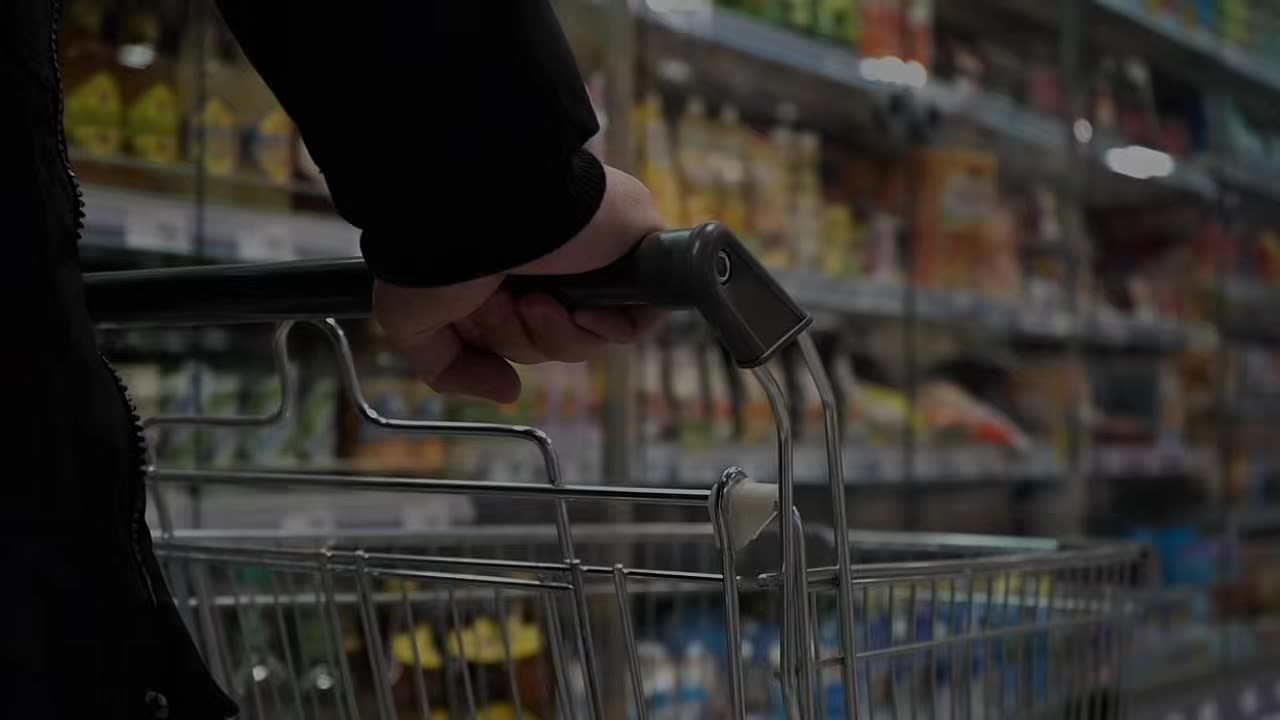
Anthony Wyatt, 60, works at an art gallery in London. In the past, he would give to his local food banks whenever he could through supermarket donation points, but the rising cost of groceries has forced him to stop. Video by Chiraag Shah.
This past Thursday, Newham District Food Bank received only a single bag of groceries from the public.
The bag contained 500g of pasta, two cans of peeled plum tomatoes, some condensed milk, and four cans of beans.
The donation totalled to a combined weight of 4kg, a fifth of what the typical food package for a family of 4 contains.
The week before, the Felix delivery had contained only potatoes. This week there were four crates, with cucumbers, cabbages, potatoes, and onions laid out along the middle of the car park in a market-style display, alongside two crates of fresh fruits like mangos and strawberries.
Vicky Torrance, Newham District Food Bank's Chief Executive, estimates that her organisation is currently purchasing around 80 per cent of the food it gives out, largely funded by the Trussell sustainability grant.
If that grant were to dry up, she says plainly, the situation would become "problematic".
Whether this is entirely due to the downstream effects of the Iran-US conflict is difficult to ascertain, particularly as Vicky reminds me that donation levels at food banks tend to fall during summer months, when the cold and the darkness of winter no longer press the urgency of hunger into public consciousness.
Source: Newham District Food Bank (Trussell)
Source: Newham District Food Bank (Trussell)
But Torrance is careful not to attribute everything to seasonal patterns. "It's hard to know," she says. "But there's definitely a drop-off."
Against this contracting supply is a steady rise in demand. At the Ascension Church Centre distribution point, the number of weekly food parcels has grown from around 15 to 18 per week at the beginning of the year to somewhere between 25 and 30. The community meal held every Tuesday, designed as a warm space for lonely or isolated residents, has also grown from around 40 attendees per week to roughly 70.
More broadly, the food bank is also seeing a rise in the number of people’s worth of food it is distributing, which goes against the typical seasonal expectation of lower demand in summer. Between March and April, the number of people’s worth of food distributed rose 12% from 465 to 521, reaching close to the January peak of 549.
Volunteers and staff set up the distribution stand ahead of the food bank opening.
Volunteers and staff set up the distribution stand ahead of the food bank opening.
According to data provided by Newham District Food Bank, in 2025, the biggest driver, or “reasons for referral”, pushing users to food banks was the rising cost of essentials, followed by "no access to financial support due to immigration" and the "ongoing impact of a physical or mental health condition".
Other common factors include a loss of zero-hour contracts and people trapped in unaffordable private rentals whose benefits do not cover their rent.
Catherine Howard, Welfare Benefits and Income Maximisation Officer at Newham District Food Bank, notes that many of those she sees are being pushed to choose between heating and eating, a phrase that has become a grim refrain in these conversations. Her role, in part, is to advise food bank users to make sure that they are getting the correct discounts on their bills, electricity and water, and find ways of boosting their income.
But, in recent months, that has been getting more and more difficult as government schemes designed to help with energy bills are slowly whittled away, while unemployment rises. In particular, Catherine has started noticing a new kind of visitor: people who have recently lost jobs in sectors being reshaped by automation and the rise of AI, from cashiers and stockroom workers to white-collar workers in IT.
"They're looking for work," she says. "But the roles they were doing in the past, they're just not there anymore"
As these wider socio-economic conditions worsen, so too does the acuteness of people's situations. This year alone, Torrance has personally conducted at least three "safety conversations" with food bank users who expressed suicidal thoughts. "People have become a little bit more desperate," she says. "I think just people are really tired."
The backdrop to that fatigue is a decade-long accumulation of crises: austerity, the Covid-19 pandemic, a cost-of-living surge, and now the Iran conflict. "It just feels like a real sense of fatigue," Torrance says. "Donor fatigue, maybe, but certainly the people at the sharp end of it."
"You know a storm is coming, but you don’t know how its going to affect you"
Vicky Torrance
CEO, Newham District Food Bank
On her part, Torrance is acutely aware of these ongoing pressures and has been taking steps on multiple fronts to prepare the food bank for the challenges ahead, though she is candid about the limits of what can be done.
The most visible innovation is the food bank’s adoption of the Bank the Food app, a platform developed during the Covid-19 pandemic that allows food banks to publish a weekly shopping list which supporters can consult when doing their grocery shopping.
Newham Food Bank currently has 103 followers on the app. When a follower enters a supermarket, the app sends a notification alerting them to what the food bank currently needs most.
“Just buy one thing. One extra thing that you could give to the food bank makes a difference. Something as simple as a tin of tomatoes or a bag of rice. If everybody bought just one item, all the local food banks would be better supplied”
- Vicky Torrance, CEO, Newham District Food Bank
Preparing for rising demand also means building capacity. On the supply side, the food bank is experimenting with self-sufficiency by supporting a local gardening group, Roots of Hope, in growing produce on site. But Torrance is realistic about its impact. “It won’t make an enormous difference as yet,” she says. “But it’s a start.”
Volunteer numbers have also increased from around nine last September to nearly 40 today. Arianna Sommariva, the food bank’s volunteering coordinator, says many new recruits are younger people who are unemployed and looking for purpose, routine and social connection.
"They don't want to stay home doing nothing. They want to keep their brain going, socialise, be healthy members of society"
Arianna Sommariva
Volunteering Co-Ordinator
Some are using volunteering as a route back into work, but Sommariva is clear-minded about what the trend reveals about unemployment at large. “It shouldn’t be like that,” she says. “People need to pay their bills.”
Even so, volunteers alone are not enough. The food bank has been without a full-time manager since April 2024 due to a lack of funds, with the responsibilities being absorbed by Torrance and a volunteer team. Filling that role, she says, would significantly strengthen the organisation’s ability to raise donations by securing partnerships with local businesses and supermarkets, better preparing them for future pressures.
But the biggest shift is philosophical. Increasingly, food banks are trying not only to meet need but to reduce it. Torrance wants Newham District Food Bank to become a community hub, bringing together housing support, debt advice, health services and, eventually, employment support under one roof.
The aim is to create what she calls “visible routes out” of poverty. “People need to be able to envisage a future without grinding poverty,” she says. “If there are visible routes, people will take them.”
Yet there are limits to what any food bank can achieve alone. Torrance’s most urgent request of government is simple: provide clearer visibility of the risks ahead. “The UK runs a just-in-time model,” she says, warning that both food banks and supermarket supply chains are vulnerable to sudden shocks.
Torrance would also like to see greater recognition of a structural inequity. Food banks in poorer areas face higher demand while drawing donations from communities with less to spare. Newham's donors are, by and large, Newham's residents, and as the statistically poorest borough in London, that wealth gap is reflected in the donation numbers. “We’re relying on the poorest people in Newham to give to the food bank,” she says. “That’s a harder model.”
Ultimately, Torrance hopes for a future in which food banks are no longer needed. Achieving that would require changes in employment, housing and social security that lie far beyond the reach of any single charity. What Newham District Food Bank can do, for now, is keep the parcels moving, the volunteers showing up, and the doors open every Thursday morning.
Newham District Food Bank operates out of the Ascension Church Centre and Baxter Road in Newham, East London. It is part of the Trussell network. Supporters can download the Bank the Food app to find and follow their local food bank, or follow Newham District Food Bank on Facebook and Instagram.
 Built with Shorthand