
The Story of Brixton Chamber Orchestra
How a Lambeth ensemble is reinventing the classical concert
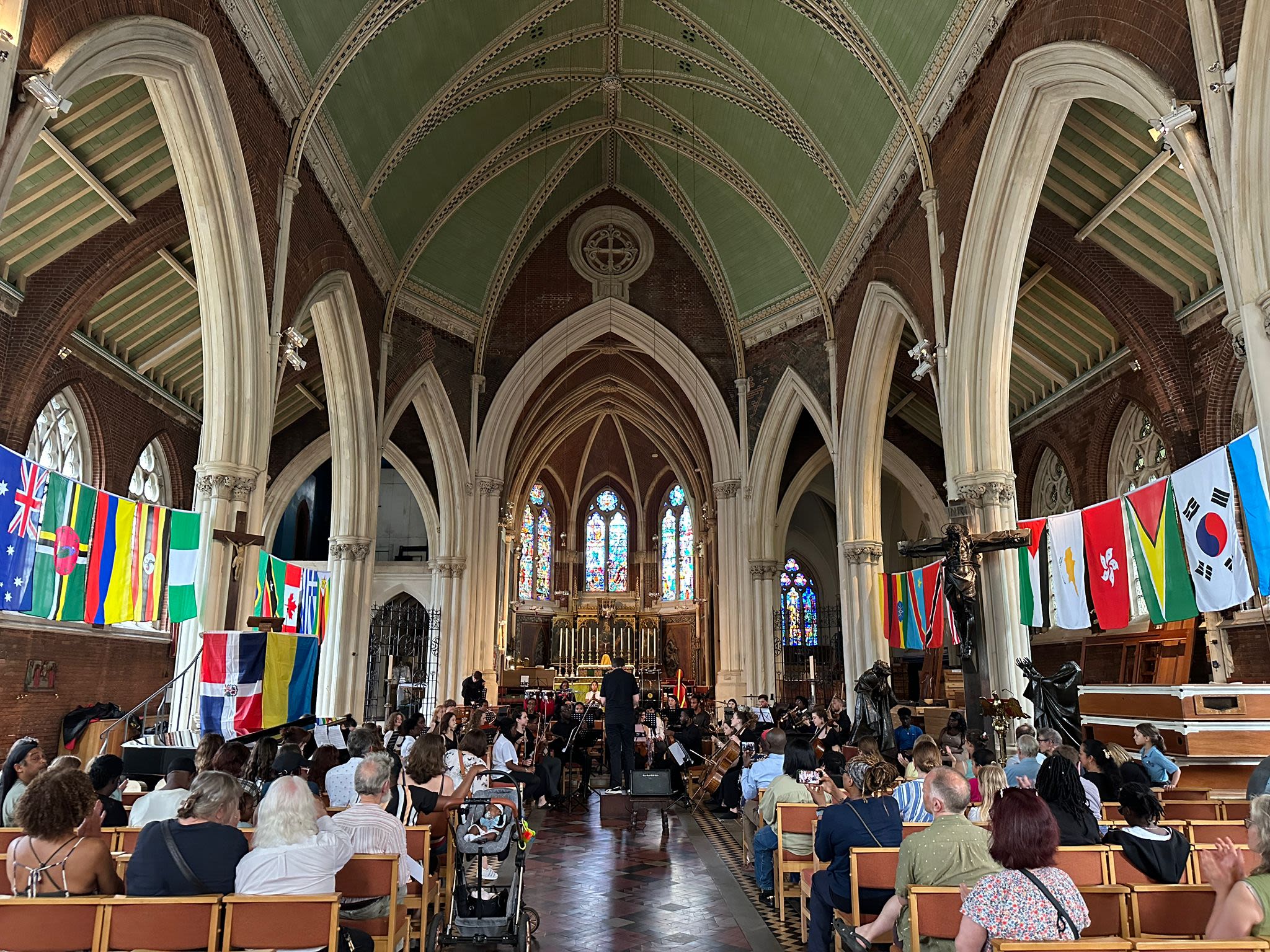

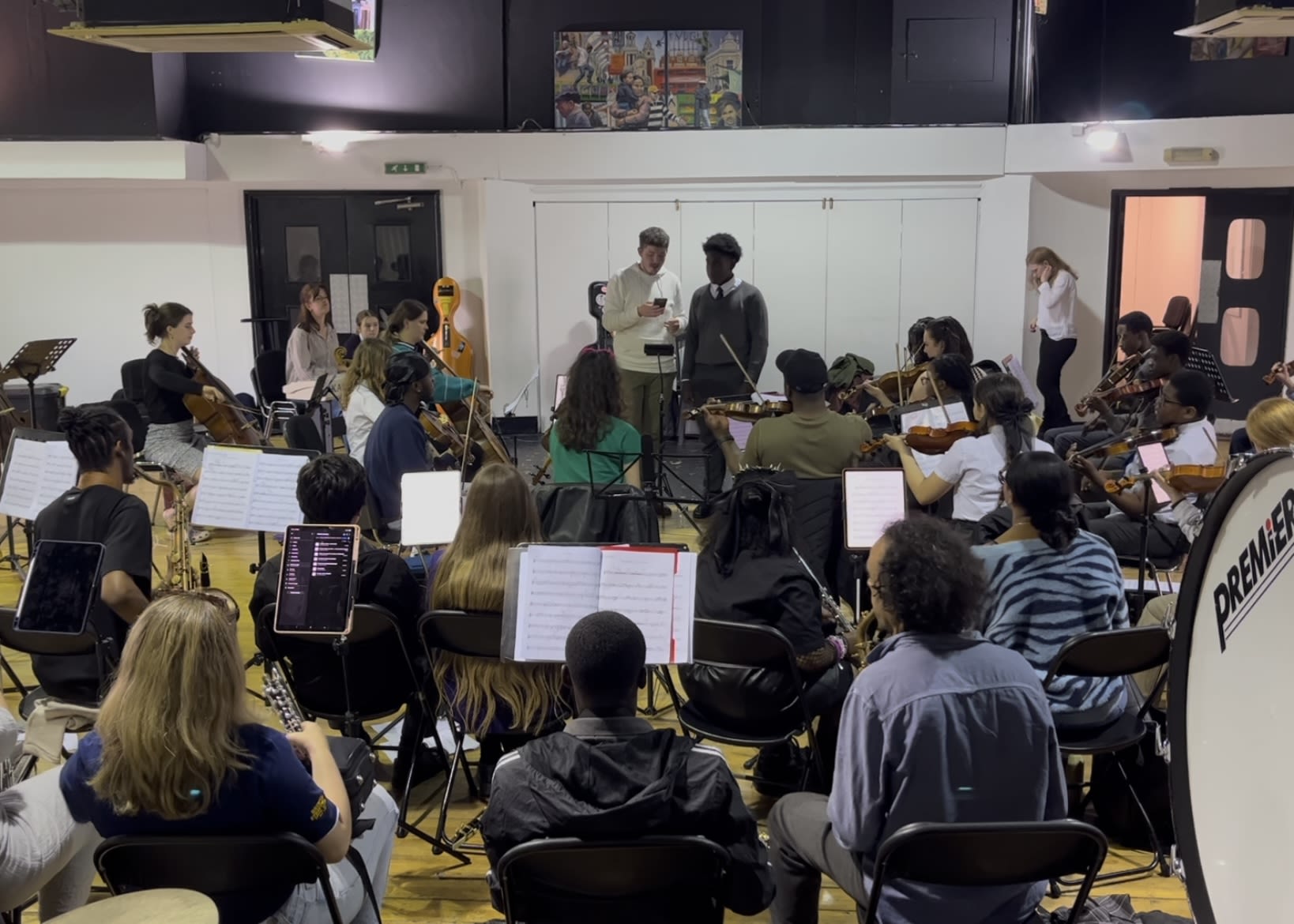
In a rehearsal room in St Matthew’s Church, Brixton, a mix of professional instrumentalists and schoolchildren could be spotted preparing for a concert.
The following afternoon they would be performing a range of classical pieces, dance tracks, and big band numbers in Brockwell Park at the Lambeth Country Show.
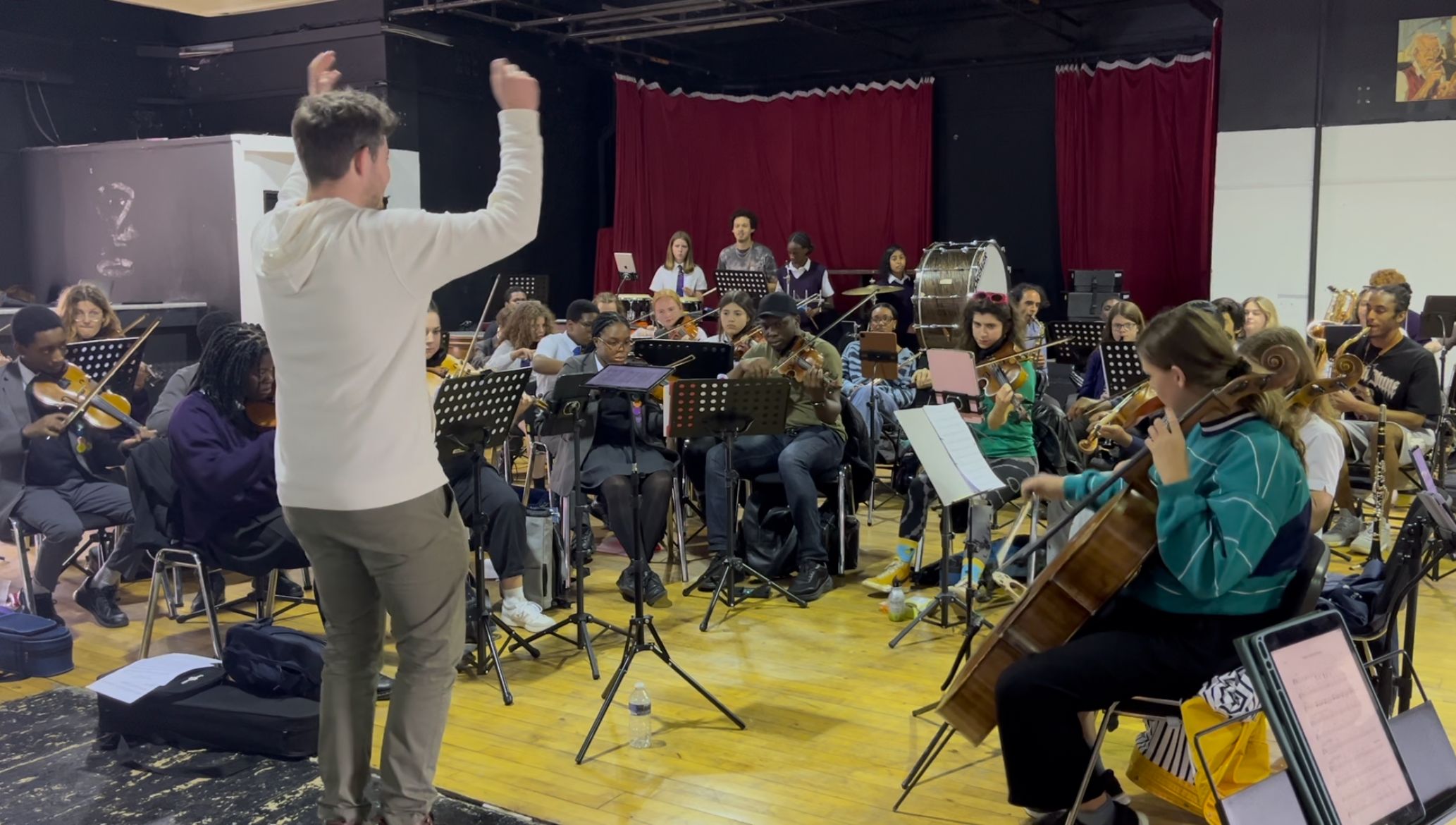
Leading the production, was the founder and conductor of the Brixton Chamber Orchestra (BCO) Matthew O’Keeffe. He was seated on a low stage, rarely moving save for the occasional shoulder shrug or flourish of the hands, punctuating the beats and swells of the music.
His was hardly a conventional conducting style – but few aspects of the Brixton Chamber Orchestra could be labelled as conventional.
The core members of the strings, woodwind, brass, and percussion sections of this ensemble are made up primarily of players from around the Brixton area.
O’Keeffe founded the BCO in 2018 after years of running into fellow musicians after concerts on the last train or night bus headed south of the river.
These frequent encounters led him to realise that, despite a great deal of these instrumentalists, himself included, living in boroughs like Lambeth, there never seemed to be any orchestral concerts given in this area.
It was then that he decided to found a dedicated orchestra made up of the musicians he’d come to consider neighbours, which would perform not in venues like the Royal Albert Hall, but on the doorsteps of the kind of people around whom O’Keeffe had grown up, who otherwise would have very little access to orchestral music.
O’Keeffe had also begun to consider what the potential for a 21st century orchestra could be, and what it could achieve.
Primarily, he knew that, in any ensemble he founded, he would want to make diversity a key component, not only of the orchestra’s members, but of its repertoire.
He said: “Straightaway, the question is what music are you going to play? Is it just going to be German symphonies, or German symphonies ‘plus’, or are you actually going to shake it up a bit?”
Now, seven years after its foundation, the orchestra has grown from its humble beginnings of just a dozen or so musicians.
Its range and innovative meshing of genres is now known and admired across the city, and, rightfully, it has received its plaudits for its community outreach, bringing orchestral music to schools and estates across Lambeth.
Besides that, it has turned the idea of concert etiquette on its head, with non-ticketed entry, the freedom for audience members to move and dance, and the invitation for viewers to perform on-the-fly with the orchestra.
(Picture credit: Charlotte Wilson)
The BCO’s earliest concerts took place in venues like the community centre at his grandparents' estate, Cressingham Gardens, which offered the ensemble free venue hire, but things ramped up a gear in the wake of a stabbing on O’Keeffe’s own estate, Tulse Hill.
The victim was well-known in the community, including to O’Keeffe.
O’Keeffe went to the residents’ association with the intention of pitching the idea of a concert by the BCO, but upon sensing the tension, hurt, and upset among the other residents, he realised that this was the wrong moment.
He said: “There was a lot of anger in the room, anger at local authorities, the social services, and even at each other.
“It was like, ‘why did we allow this to happen?’ ‘Why did we not know who was on our estate?’ ‘Why are we siloed up in our flat?’”
He realised that there was more at stake than simply entertainment in the form of concerts, and that, if he wanted to trade off the name ‘Brixton Chamber Orchestra’, he would have to contribute more to social cohesion.
This realisation birthed the Estate Tour, for which the BCO is now perhaps best known.
Matthew O'Keeffe leading the wind section rehearsal. (Video credit: Charlotte Wilson)
(Video credit: Charlotte Wilson)
O'Keeffe said: “Maybe in a small way, bringing a really good musical set around, in very community-centred settings, would give residents more of an excuse to self-organise, to put on things for each other, to get to know each other better, and seven years later, I think that’s proving to be true.”
O’Keeffe recalled pitching the idea early on to some estates, who replied that it wouldn’t be possible to stage a concert, as they had no organising committee in place to handle it. Four or five years later, however, the estates would make contact again, telling him that a committee had since been formed, and that they would love to organise an event.
He said: “You do see if you can provide a linchpin, that people really want to come and see, everything else will kind of slot into place around that.”
At the BCO’s first Estate Tour concert, the players set up their instruments, and prepared to commence their unconventional and innovative set, but as 7pm arrived, the audience capacity amounted to zero.
O'Keeffe said: “I had this horrible sinking feeling, I thought, ‘this is going to be a nightmare.’ The players were all downhearted as well.
“I tried to gee everyone up, saying, ‘come on guys, it will be alright. Let’s just play the music through and do it like a dress rehearsal, then tomorrow we’ll be on it, and people will come.’”
After twenty minutes of playing, he noticed the orchestra’s expressions changing, and turned around to see the entrance of around 40 Colombians, with the Indoamerican Refugee and Migrant Organisation, a charity working with South Americans in South London.
O’Keeffe learned that they had all organised to meet up and walk to the concert together.
He said: “That clash of concert etiquette and the reality of what we were trying to achieve came together in this glorious clash, and we just started again.”
This unconventionality of prioritising the audience's comfort, convenience, and experience over obeying strict concert etiquette crossed over into other features of the BCO's concerts.
For instance, they introduced an ‘open mic’ section at the end of their concerts, after one concertgoer ran to the front and insisted on joining in.
Recalling that incident, O’Keeffe said: “We were ready for it to be s**t, and actually he just kind of invented this vocal top line over the beat that we were playing, and it was so convincing.
“There was this latent talent in the regular people who aren’t professional musicians by any stretch, but a lot of them really can perform.”
(Picture credit: Charlotte Wilson)
As the success of the band has progressed, O'Keeffe now invites audience members to come up and join in, a feature which has proven particularly popular with rappers. He’ll ask them to perform a few bars to give the ensemble an idea of the tune, and with that, they improvise an accompaniment.
On the question of social barriers to classical music, O’Keeffe argued that the biggest barrier was a mental one, given that a ticket to an orchestral concert is often cheaper than one to the cinema, with concert halls across the nation providing subsidies to some of the most noted orchestras.
The London Philharmonic Orchestra, for example, offers discounted tickets to those under 30, and the English National Opera offers free tickets for those under 21.
On the other hand, O’Keeffe remarked that the wider public doesn’t seem to be very aware of these cheap tickets, meaning that the accessibility issue remains in place.
He said: “There’s a behavioural point and there’s a perception point. I think the perception is that it’s a fancy place, a lot of people there are in suits, and it’s a middle class thing to do.
“And also, it’s going to be intimidating – can you sit there in silence, very still, for two hours?
“Part of that is that it’s necessary for everyone else, you know, if you’ve got a thousand people in a big room and the orchestra isn’t amplified, you’ve got to shut up. You can’t be getting up and going for a walk.”
Another barrier O’Keeffe has identified is in the process of booking, which estranges homeless people in particular from concerts.
For this reason, many of the BCO’s concerts are held outside, in easily accessible spaces, and with no QR code tickets necessary.
This in turn means that the organisers have no idea how many people intend to show up, but for O’Keeffe, that’s a risk worthy of taking - in fact, to his mind, risk is a fundamental component of funded arts.
He said: “You’ve got to be willing for it all to fall apart. Are you going to insist on rehearsing everyone who’s going to come up and sing and rap with the orchestra? Well then they’re not going to do it are they?
“Are you willing to let it be a bit bad a few times? Because that’s how you really engage people. You take the risk, you take the musical risk.”
About half of the orchestra’s costs are funded through grants, and O’Keeffe estimates that about one in ten of the grant applications submitted receives approval. For the rest of the funding, they rely on the BCO supporter scheme, which receives donations on a subscription basis.
The orchestra is also eligible for orchestral tax relief, which aims to put money back into orchestras and theatres, and receives sponsorship from companies including Brixton Brewery, whose partnership has been ongoing for about five years.
“There was this latent talent in the regular people who aren’t professional musicians by any stretch, but a lot of them really can perform.”
- Matthew O'Keeffe -
Hannah Littlechild rehearsing the string section. (Video credit: Charlotte Wilson)
Hannah Littlechild rehearsing the string section. (Video credit: Charlotte Wilson)
However, O’Keeffe maintained that the state of arts funding is notoriously worrisome these days, with funders eager to see more concrete results from their input.
He said: “If I want money to put on five massive concerts in the middle of a poor space, which is going to be watched by a load of poor people, and it’s going to contribute in some ineffable, intangible way to the sort of civic pride of the space, to the social cohesion and to the well-being of everyone present, well that’s great. Well done you.
“But how can you prove that? You’re not going to follow all 600 of those people who came to your concert. You can only get very superficial feedback from them.”
Rather, he said, funders often choose to invest in smaller scale projects which, for the same money, target a dozen or so people, who may, for instance, be refugees or have been through some kind of trauma, so that the funders have tangible evidence of positive outcomes.
Despite both organisers and spectators alike recognising that the Estate Tour concerts improve social wellbeing and community building, it's difficult to prove that result quantifiably to investors.
He continued: “We’ve only been doing it for six years. Maybe after 10 years I could point at actual reductions in crime or stuff. But it’s that intangible thing that arts at centre of community is important.”
O’Keeffe explained that music-making is a kind of metaphor for communication and collaboration.
He continued: “When you see 40 people playing complex music together, the amount of cooperation across the different types of people in one display, it is inspiring.
He described how the very concept of, for instance, opera is entirely irrational, with its costliness, its time constraints, and the fact that only a performance would play to only a few hundred people.
O' Keeffe said:“It only works live, but it’s worth it because all art is worth it. Because it elevates your soul to a place that you can’t get to in the free market economy.
“That sounds kind of wishy-washy, but if you fill your civic places with art and performance, you create a bowl in which people are more understanding to each other, that they have shared an experience of joy together, you’ve shared a moment of joy with them.
“In a society where people talk often about how individual we all are and you can basically live a cocooned existence in your house and your work and online, we need more shared experiences out in the public space together."
Besides that, an orchestra is an inherently inclusive body, able to grow to accommodate as many people as desired. It is inherently community oriented.
The community spirit of the orchestra is particularly evident in the fact of so many instrumentalists returning to it time and time again.
Hannah Littlechild describing her work with the BCO.
Hannah Littlechild, 27, who often leads BCO’s violin section, plays with the orchestra in between touring in the pit of major musicals, such as The Phantom of the Opera.
Mebrakh Haughton-Johnson, 26, a clarinettist, played in the ensemble in its early iterations, before winning a place at the ultra-elite New York performance school, Julliard, and subsequently returned to play with the BCO again afterwards.
Mebrakh Houghton-Johnson speaking about his musical career with the BCO.
(Picture credit: Charlotte Wilson)

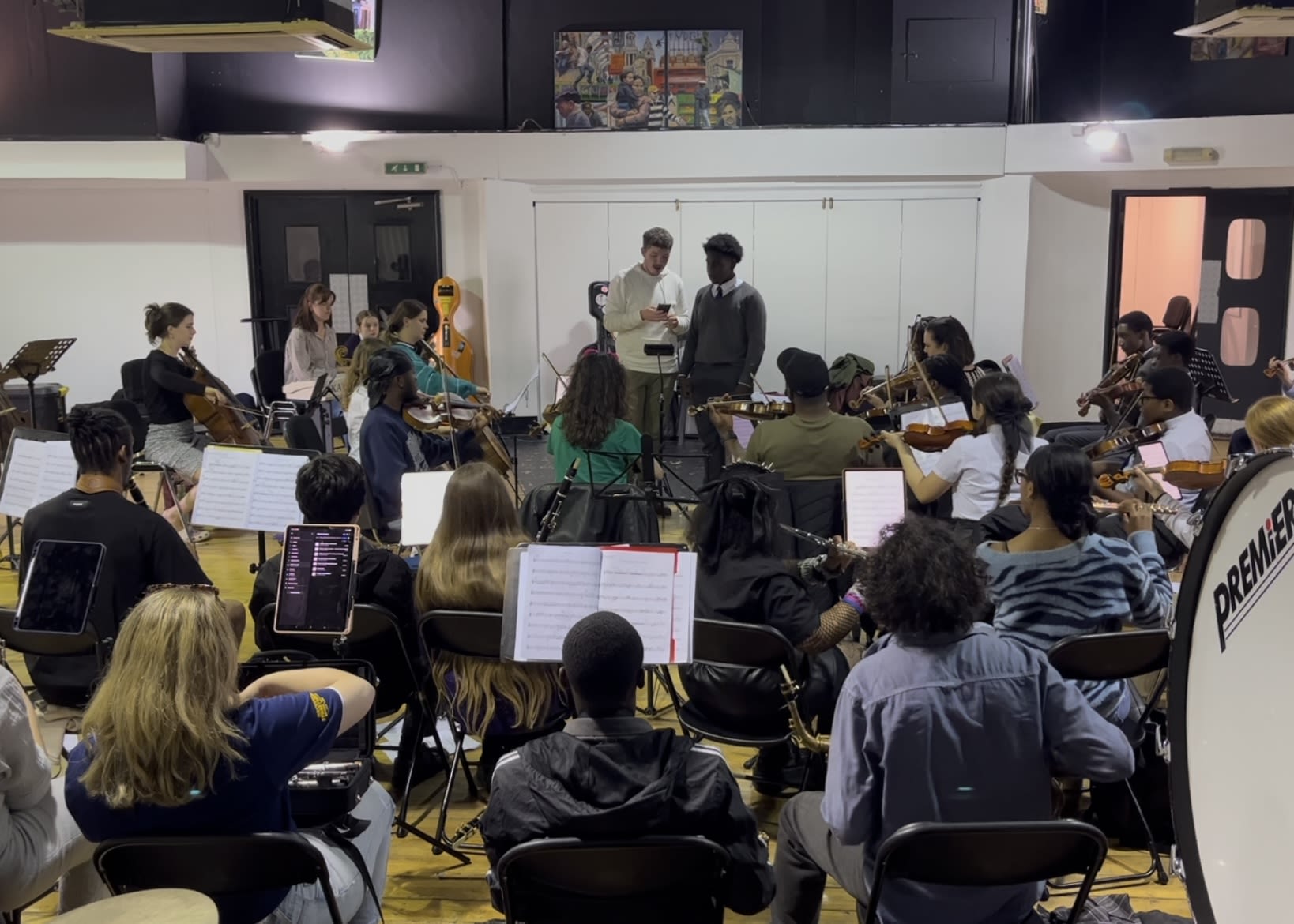
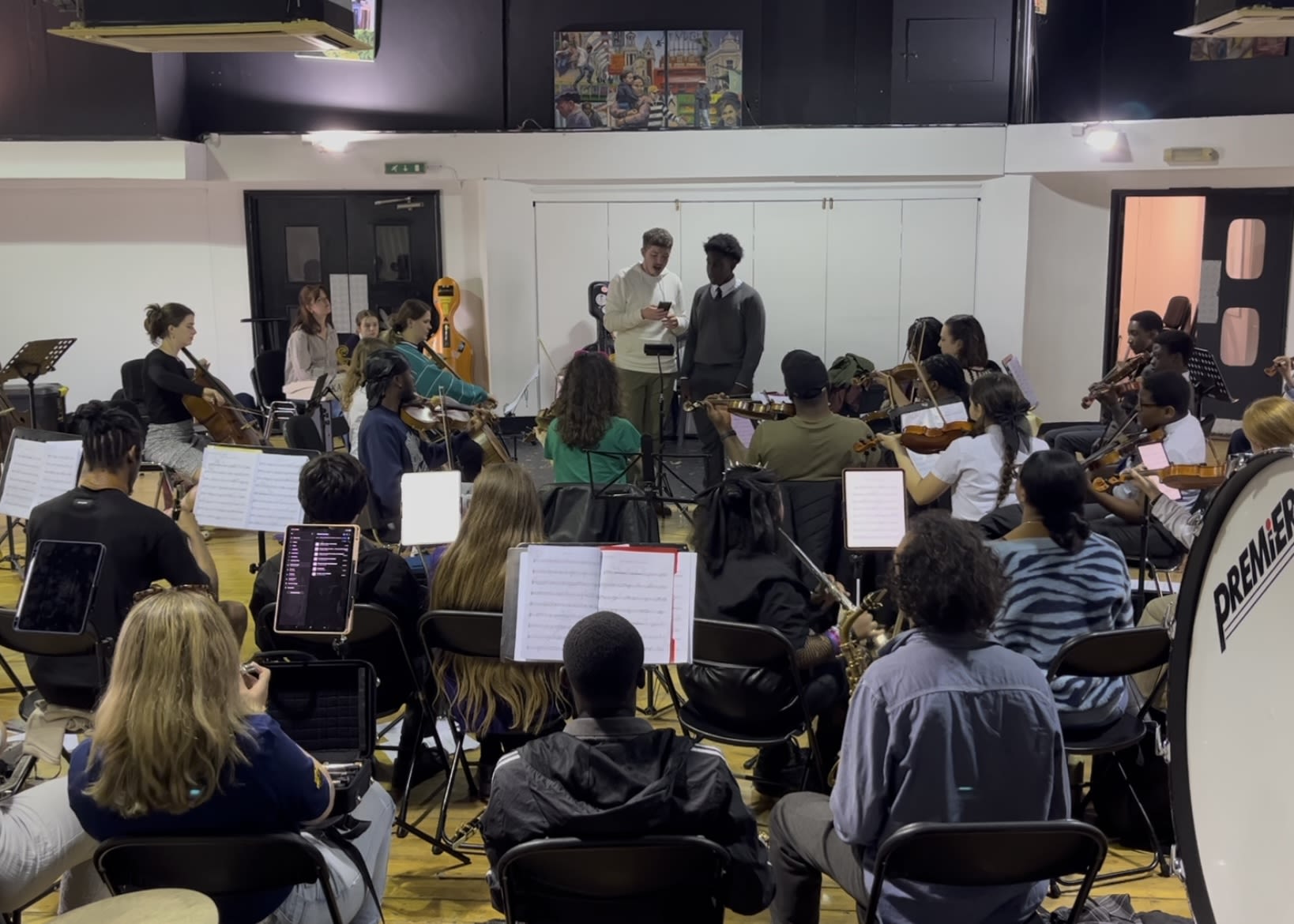
Haughton-Johnson said: "None of the other orchestras and ensembles that I play with do as much community outreach and I feel like it's really really important, and particularly special for students in these communities to see people on stage that might share their background."
The BCO places a huge emphasis on involving amateur players, including the Lambeth schoolchildren who were rehearsing that afternoon, into their ensemble, reaping multiple benefits for both the ensemble and volunteers.
It firstly means that O’Keeffe is able to increase the size of the orchestra on a shoestring budget, with volunteers amping up the sound of more sparse sections.
It also allows amateurs the hugely beneficial opportunity to play alongside a professional ensemble, which both improves their performance technique, and makes up for some of the shortfalls of the current music syllabus in schools, something which particularly concerns O’Keeffe.
In recent years, major exam boards have lowered the requirements for music, where once it was a requisite that candidates were at grade five level at GCSE and grade eight at A-level.
He argued: “If you’re leaving school at grade five, you can’t go anywhere. You can’t do an undergrad. You’ve missed the boat arguably.
“In a well-meaning effort to be more accessible and sort of reach out to different kinds of music, you’re actually depriving kids from non-private schools to really understand the written music. If you can’t read music, you’re much less employable.”
According to data from the Sutton Trust, among top classical musicians, 43% attended an independent school, whilst the British independent school attendance rate is approximately 6%.
By incorporating secondary students into the ensemble’s work, O’Keeffe hopes to give them the best preparation possible for professional musicianship.
Reflecting on the orchestra’s highlights so far, O’Keeffe remembers with particular fondness the Orchestrated Series, in which genres like grime and disco were fused with classical music.
“It doesn’t sound like crossover, because a lot of the time when you say that, people just imagine Andrea Bocelli singing a Spice Girls song or something.
“It’s not like that – I want to bring aspects of one type of music into the other and vice versa.”
He recalled a performance of a particular movement in Mahler’s Second Symphony sung by a mezzo-soprano, where they commissioned a translation into a sort of southern state Pentecostal gospel English, and had it performed by a gospel singer.
Innovation is truly at the heart of everything the BCO does, and, looking ahead to their upcoming fourth iteration of the Brixton Opera Gala, audiences can be sure to have their every preconception of classical music shaken very soon.



 Built with Shorthand