
What can we learn from medicinal herbalism?
How 'befriending' plants can change the way we see
This one can kill you
"This one can kill you", the herbalist and gardener Camila Barboza says cheerily, as we stomp through the long grass in Hackney Marshes to a thicket of tall flowering plants. She snips off a stem and twirls it between her fingers, warning us that eating just a couple of leaves of poison hemlock would be fatal.
Plant identification with Hackney Herbal
I am familiar with the plant. The philosopher Socrates was famously executed using hemlock back in 399 BCE, and it grows abundantly in the cracks of concrete in my backyard. Yet, out on a Herb Walk with Hackney Herbal, I missed the characteristic purple blotches on the stalks, mistakenly suggesting the poisonous plant was cow parsley. Two experienced foragers were rescued from Sully Island, off the Welsh coast, in May last year after making a similar mistake.

Poison hemlock. Credit: Ivy Burnett
Poison hemlock. Credit: Ivy Burnett

The Death of Socrates, Jacques-Louis David, 1787. Public domain, via Wikimedia Commons
The Death of Socrates, Jacques-Louis David, 1787. Public domain, via Wikimedia Commons
Hemlock
Cow parsley
Camila Barboza, of Hackney Herbal. Credit: Ivy Burnett
Camila Barboza, of Hackney Herbal. Credit: Ivy Burnett
Foraged plants from Hackney Marshes. Credit: Ivy Burnett
Foraged plants from Hackney Marshes. Credit: Ivy Burnett
Camila believes getting rid of hemlock from public spaces would be ‘human-centric’: just because it’s poisonous to humans, doesn’t mean its place in the ecosystem isn’t important.
She reiterates the idea of respect, of getting to know plants, and ‘befriending’ them.
"Once you get to know a plant, it’s a familiar face, in the same way as a familiar human face, but also in the sense that you know they can look after you if you need," she says.
As Camila leads the group of ten or so enthusiasts around the marshes, the focus is often on what the plants can do for us. She discusses bitterness deficiencies, plants for making soothing topical creams and natural fertilisers, and aiding with emotional support, wound healing, and seasonal allergies.
Once you get to know a plant, it’s a familiar face
Camila has other creatures in mind too.
Camila Barboza from Hackney Herbal. Credit: Ivy Burnett
Camila Barboza from Hackney Herbal. Credit: Ivy Burnett
A fellow participant shared that she’d lived in Hackney for years but had never been to the marshes. People are seeking nature connection as much as health tips, and it seems that knowing the plants around us can change how we relate to the world (and stop us from eating something deadly).
“The grass you walk on is never just grass,” Camila says.
She shares that she finds plantain "much better for nettle stings than dock leaf. You can turn it into a paste using a blender or pestle and mortar and it’s really amazing".
Camila advocates for sustainable foraging, saying that you cannot remove roots of the burdock (to make dandelion and burdock) because its illegal without permission of the landowner, and because the plant would no longer exist and “you wouldn’t know how many people are also removing them.”
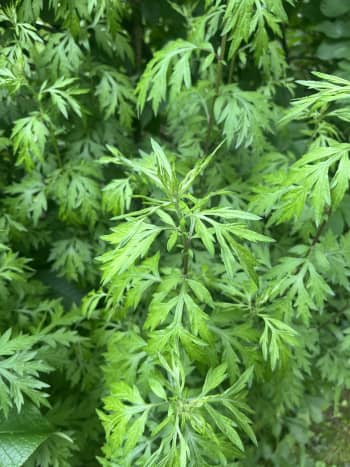
Camila also discusses some folklore. The elder tree in particular has a long history of folklore and superstition across northern Europe.
She tells a story of a whole village in Ireland who successfully stopped an elder from getting cut down to avoid causing misfortune, illness or even death.
"Whenever I'm cutting things in the garden I ask permission," she says, "But I'm a bit scared of the elder entity."
A 1610 legend tells of an invading king turned to stone by a witch, who then became an elder tree. Rollright Stones, Richard Smith, CC BY-SA 2.0, via Wikimedia Commons
A 1610 legend tells of an invading king turned to stone by a witch, who then became an elder tree. Rollright Stones, Richard Smith, CC BY-SA 2.0, via Wikimedia Commons
Ribwort plantain. Credit: Ivy Burnett
Ribwort plantain. Credit: Ivy Burnett
I find plantain much better for nettle stings than dock leaf
Elder. Credit: Ivy Burnett
Elder. Credit: Ivy Burnett
We each taste a petal from the wild dog rose, its soft velvety texture at first tasteless before an unmistakeable rose aftertaste lingers in the mouth for minutes.
Herbalism Today
Interest in herbalism is on the rise. Sukvinder Bhamra, a Senior Lecturer in Pharmacy Practice at the Medway School of Pharmacy, points to Covid-19, celebrity influencers, and the widely-held view that natural products are safer than synthetic medicines, in her research on herbalism's revival.
Foraging walks, medicine-making workshops, and wellness retreats are listed in the hundreds on Eventbrite alone.
Consumers are also buying more herbal medicine. The World Health Organisation estimates that its global market size will increase fivefold by 2030, reaching over 328 billion US dollars from 70 billion in 2023.
According to healthcare consulting firm DelveInsight, pharmaceutical companies are meeting global consumer demand by “elevating herbal medicine from folk remedies to regulated healthcare products, blending tradition with science”.
The industry that many herbal medicine users distrust is now herbalism’s biggest investor.
Roughly 80% of the global population use herbal medicine for some aspect of their primary healthcare, according to the WHO.
Writing in Wort, a herbalism journal, Cassidy McKenna says that traditional knowledge of herbs is deprioritised in comparison to randomised controlled trials, in vitro experiments, and standardised extracts – treated instead “always as past, never as present tense.”
She points out that herbalism is more a part of people's lives than it first appears. People use chamomile tea to sleep or soothe an upset stomach, or rub a dock leaf on a nettle sting.
Roughly 80% of the world’s population use herbal medicine for some aspect of primary healthcare
17th century botanical illustration. Culpeper, Nicholas; Sibly, E.; Stalker C., Public domain, via Wikimedia Commons
17th century botanical illustration. Culpeper, Nicholas; Sibly, E.; Stalker C., Public domain, via Wikimedia Commons

Sarah Turton's promotional flyer. Credit: Ivy Burnett
Sarah Turton's promotional flyer. Credit: Ivy Burnett
The Chelsea Herbalist
I visit Master Medicinal Herbalist and Iridologist Sarah Turton in Chelsea for an “introduction to herbal medicine”.
She shares case studies, including an ex-GP with long Covid who can now walk his grandchildren to school again, and a woman in her late 50s whose GP couldn’t help her with exhaustion, poor sleep and longstanding anxiety, but who “felt like herself again” after six months of herbal intervention.
Sarah’s passion for herbalism began after her sister developed brain cancer: they tried every medical modality they could, “but it was herbal medicine that gave my sister the most tangible relief.”
She worked in medical pathology for 18 years, seeing patients’ toes and fingers being amputated during treatments for diabetes.
“I thought there had to be a better way, and herbalism is the better way.”
Sarah is nonetheless careful to position herbal medicine alongside rather than instead of conventional medicine.
She prescribes around 40 different herbs in her teas, tinctures, and capsules, and charges £495 per single consultation and £1500 for a six-month Deep Reset (four appointments at £375 each), saying: "There is no better investment than your health."
There is no better investment than your health
Sarah tells me that she does share her formulas’ ingredients lists with her clients, but she doesn’t share the exact recipes.
She named no specific herbs during the free talk.
Herbalism History
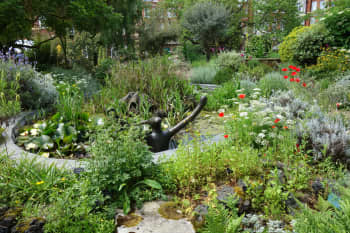
Down the road, I visit the Chelsea Physic Garden – ‘physic’ referring to the science of healing. It was founded in 1673 by the Worshipful Society of Apothecaries. Its high walls create a microclimate, allowing plants from all over the world to thrive in its various rock gardens, hot houses and meticulously-labelled herb beds.
The garden’s seed exchange programme began in 1682, and among its exports were cotton seeds to the colony of Georgia in the American Deep South.
The institution says it has been connecting people with plants for 350 years.
It opened to the public in 1987.
The Physic Garden, Chelsea: men botanizing in the garden, near the statue of Sir Hans Sloane, 1750. Wood engraving by T. W. Lascelles after H. G. Glindoni, 1890. Wellcome Collection, CC BY 4.0, via Wikimedia Commons
The Physic Garden, Chelsea: men botanizing in the garden, near the statue of Sir Hans Sloane, 1750. Wood engraving by T. W. Lascelles after H. G. Glindoni, 1890. Wellcome Collection, CC BY 4.0, via Wikimedia Commons
The placard speaks of the “gradual replacement” of female healers by male apothecaries from the 1400s, with no mention of the witch hunts - though it acknowledges that the indigenous healers and the apothecaries, deemed “more acceptable”, used much of the same knowledge.
The Chelsea Physic Garden notes that women were allowed to become apothecaries from 1877, and their numbers grew rapidly. It also celebrates its first female Head Gardener and Head Curator in 1990 and 1991 respectively, and today it is run largely by women.
Participants at each of the herbalism events I attended were almost exclusively women, too.
Wellcome Collection, CC BY 4.0 via Wikimedia Commons
Wellcome Collection, CC BY 4.0 via Wikimedia Commons
Culpeper, Nicholas, Public domain, via Wikimedia Commons
Culpeper, Nicholas, Public domain, via Wikimedia Commons
Culpeper, Nicholas, Public domain, via Wikimedia Commons
Culpeper, Nicholas, Public domain, via Wikimedia Commons
Nicholas Culpeper, 17th century herbalist, died 19 years before the Chelsea Physic Garden first opened. He deliberately published his herbal writings in English rather than Latin to make plant medicine accessible to those who could not afford physicians. A community garden is named after him, in Angel.
Medicinal London

Solidarity Apothecary care package. Credit: Nicole Rose
Solidarity Apothecary care package. Credit: Nicole Rose

The Prisoner's Herbal. Credit: Nicole Rose
The Prisoner's Herbal. Credit: Nicole Rose
Herbalism as Mutual Aid
Nicole Rose is a clinically-trained herbalist and founder of the Solidarity Apothecary. Her journey to plants didn't start in a garden or workshop. It started in prison.
She served three and a half years for charges related to animal rights activism, when she was just 21.
“When I got sent down, I was expecting to be totally removed from nature, but I remember that first night where I was taken across the main courtyard… I looked down and I could see dandelions pushing through the concrete. I could see magpies and crows on the prison walls and fences. I knew that I would find comfort in witnessing this world’s resistance.
I knew that I would find comfort in witnessing this world’s resistance
“The mission of the Solidarity Apothecary is to materially support revolutionary struggles and communities with plant medicines to strengthen collective autonomy, self-defence, and resilience to climate change, capitalism and state violence.”
Nicole describes discovering yarrow and daisy in the main courtyard, and mallow and plantain by the fences. She smuggled wild leaves past the prison officers to her friends, making them cups of tea to soothe period pains and cramps.
She says that witnessing the intense medical neglect of mothers and babies behind bars was a motivating factor in writing her book, The Prisoner’s Herbal, which is distributed to prisoners worldwide and focuses on plants growing in prison yards and ingredients available in the canteen.
“Herbalism is incredibly empowering because plants give us the opportunity to actively care for our own health without fighting authority,” she says, adding that prison food is awful and wild plants can supplement diets, supplying much needed vitamins and minerals.
Herbalism is incredibly empowering because plants give us the opportunity to actively care for our own health
“Connecting with plants in prison is not just about making medicine, it’s about friendship, it’s about contending with the isolation, despair, trauma, and violence.
“I would therefore encourage people, not just to make things with the plants they find or use them for health ailments, but to try and make friends with plants in the herbal world.
“We can build friendships with plants by simply hanging out with them, sitting with them and drawing them and tasting them.”
Try and make friends with plants... by simply hanging out with them, sitting with them, and drawing and tasting them
Nicole says her friends laugh at her for talking to plants, but that plants comfort her.

Yarrow. Credit: Ivy Burnett
Yarrow. Credit: Ivy Burnett

Daisies. Credit: Ivy Burnett
Daisies. Credit: Ivy Burnett

Plantain. Credit: Ivy Burnett
Plantain. Credit: Ivy Burnett
Among the Solidarity Apothecary’s projects is Ukraine Herbal Solidarity, a grassroots initiative led by Ukrainian and international herbalists who gather medicines grown, prepared, and donated from all over the world.
"Ukraine has a really vibrant, incredible tradition of herbal medicine. Valerian sold out on day three of the invasion," Nicole says.
"We have different tinctures, like skull cap, rose and hawthorn, and things for immune support, stress support, sleep, and muscle pain.”
Their clinic site is in Poland at a petrol station at a border point, where different coaches stop and cross between Poland and Ukraine.
Valerian sold out on day three of the invasion
Cassidy McKenna writes that standard healthcare “requires stable electrical currents, constant refrigeration, sterilisation. All things that can be removed in a moment – by a bomb, a cyber hack, a flood.”
The precarity of our access to healthcare was reflected by a fellow audience member at Sarah Turton’s talk, who suggested NHS waiting times may be driving herbalism’s revival.
How well do you know your plants and herbs?
Elderflower cordial recipe. Credit: Ivy Burnett
Elderflower cordial recipe. Credit: Ivy Burnett
Relational Herbalism
We sat with our eyes closed as a mystery plant was brought before us. The scent hit me, sweet and pungent, as I was invited to notice its felt presence.
A “plant kinship circle” attracts few participants, perhaps due to immediate associations of airy-fairy new-ageism. Yet three of us sit on soft pouffes surrounded by jars of dried herbs and sculptural pieces of bark, in Claire Loussouarn’s living room in London Fields.
We used our senses to explore the fresh creamy white flowers, each with five petals and five stamen extending outwards like tiny fireworks, its blossoms smelling zingy and fresh, heavy and sweet.
I knew it to be elderflower, but I’d never looked so closely, wobbled it around in my hands, or let it move my body before. I arched my back and stretched my arms, playful and heavy, echoing the flowers themselves.
"It's not for everyone," Claire acknowledges, "but whoever wants to come is welcome."
Claire is a somatic movement artist and “insight herbalist”. Trained at the School of Intuitive Herbalism, she prefers to encourage people to find out what works for them “more in the sense of empowerment” rather than a teacher-student dynamic or giving medical advice.
She says: "When I work with people and plants, I’m just encouraging them to follow intuition. It’s like we haven’t learned to trust [that knowledge] and we dismiss it."
When I work with people and plants, I’m just encouraging them to follow intuition

Claire holding a sprig of mugwort. Credit: Ivy Burnett
Claire holding a sprig of mugwort. Credit: Ivy Burnett

Claire's dress naturally dyed with mugwort leaves, used for a performance. Credit: Ivy Burnett
Claire's dress naturally dyed with mugwort leaves, used for a performance. Credit: Ivy Burnett
Claire talks about the importance of returning to the same place and watching it change throughout the seasons, and connecting with each plant.
“I don't see just greens - I see dandelion, I see yarrow. It's not just a big blur.”
She thinks more people would be open to this way of seeing, saying: "I think if people had more of a chance, they would be quite open. It doesn't need to be so airy-fairy - some of it is not having the opportunity."
I see dandelion, I see yarrow. It’s not just a big blur
Herbalist Hannah-May Batley writes about top-down processing – when the brain applies what it knows to fill in the blanks and anticipate what’s next – and bottom-up, which relies upon a perceptual and sensory process, received in the moment.
She writes that top-down processing damages our capacity for awe and our ability to deepen our understanding of beings which are made familiar – even boring – through this framework.
Describing an “experiential journey with a Blackberry”, she advocates “looking like it's the first time, seeing like it's the last.”
Integrating this perspective into everyday life can create ethical tensions. Claire says if she starts to be too conscious of her impact on the environment, “what I walk on and what I kill”, then she couldn’t do anything.
But she believes being in relation with plants creates better ways of relating to the world: of care, commitment, and giving back.
Still, she thinks it’s important not to romanticise or idealise nature connection.
“It just feels more true to connect with them at that level. Maybe there’s a lot that we can learn by doing it.
“I enjoy the landscape differently. It’s not just somewhere I walk but it’s a land I’m in relationship with.”
It’s not just somewhere I walk but it’s a land I’m in relationship with
It’s a way of seeing - and being - that, for many, was never taught.
As Nicole Rose says, "in my generation, you’re much more likely to be able to identify thousands of corporate logos than you are even the most basic of plants growing in your garden or in the city where you live."
 Built with Shorthand